Thinner than a human hair: the extraordinary engineering of Bible paper
Three quarters of a million words in a single portable volume. The secret is the paper.
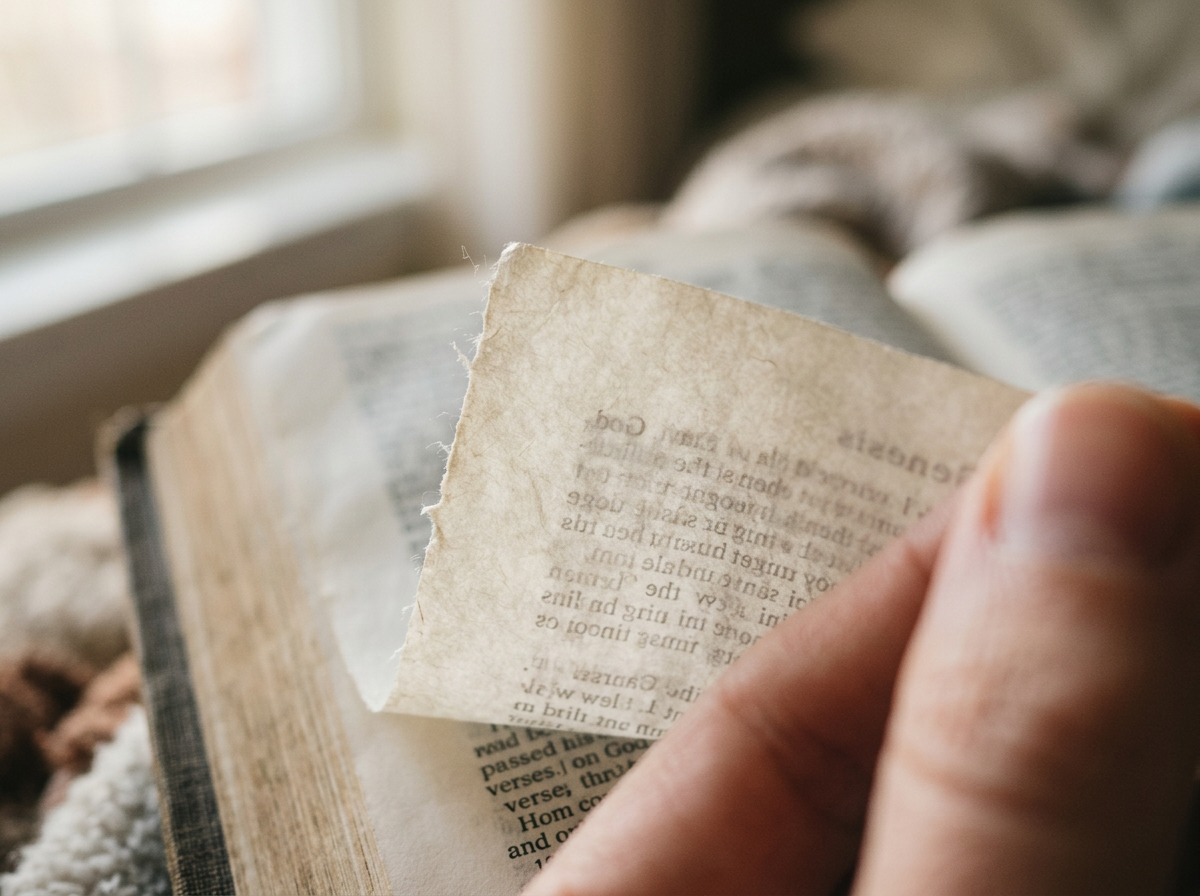
A single sheet of translucent India paper held up to soft window light.
A Bible contains roughly 750,000 words. That's six or seven novels stacked together. And yet it sits in your hand as a single, portable volume — small enough to carry in a coat pocket, light enough to hold open one-handed for hours.
The secret is the paper. And once you understand it, you'll never look at a book the same way again.
Thinner than a hair.
Standard office paper weighs 80 grams per square metre — what printers call 80gsm. Bible paper, also known as India paper, weighs between 25 and 40gsm. A single sheet may be as thin as 0.04 millimetres — finer than a strand of human hair. At that thickness, you can fit roughly a thousand pages within a single inch of book.
“Standard office paper weighs 80gsm. The finest Bible paper weighs 28gsm — and it's stronger.”
But the magic isn't just thinness. Anyone can make paper thin. The magic is making paper this thin and still keeping it strong, opaque and crisp under ink. That requires a particular kind of engineering.
Long fibres, carefully chosen.
Bible paper is made from a blend of long cellulose fibres — typically cotton, linen, and chemical wood pulp — chosen specifically for their tensile strength. The fibres are purified, blended, pressed and dried on steam-heated cylinders, then passed through calendering rollers that compress the surface to a glassy smoothness.
Long fibres are crucial. Short-fibre paper tears easily; that's why newspaper crumbles after a year on a shelf. Bible paper is engineered to be flipped, folded, dog-eared and underlined for fifty years and remain intact.
The opacity problem.
The great technical challenge of Bible paper is opacity. Paper this thin should be transparent — the ink on one side bleeding through to the other, making both sides unreadable. So how do you make paper that's almost translucent, but doesn't show through?
Titanium dioxide. During production, manufacturers add tiny particles of titanium dioxide to the paper slurry. These particles scatter light internally, dramatically reducing show-through. The more titanium dioxide, the more opaque the paper — and the more expensive.
On the very finest Bibles, this is paired with line-on-line printing — meaning the text on one side of every page is precisely aligned with the text on the reverse. The lines of show-through fall behind the lines you're reading, instead of between them, which makes the page feel cleaner. Achieving line-on-line requires the press to run at a slower speed, with tighter tolerances. It is one of the hidden costs of quality.
Acid-free, for the long haul.
A Bible is expected to last a lifetime — and quite often, longer. So Bible paper is acid-free: a formulation developed in the mid-twentieth century to replace the acidic wood-pulp papers that caused earlier books to yellow, brittle and crumble within decades.
Open a 1950s paperback novel and you'll likely see paper the colour of weak tea, edges flaking. Open a Bible printed twenty years later on acid-free India paper and the pages are still clean white, still flexible, still strong.
Calibrated for ink.
The surface of Bible paper is calibrated, almost obsessively, for ink absorption. Too porous, and the ink feathers and spreads, blurring fine type. Too smooth, and the ink sits on the surface and smudges. The result of getting it right is paper that holds crisp, sharp text at very small point sizes — because Bible text is typically set smaller than almost any other book you'll encounter.
“Bible paper is made for one of the hardest jobs in publishing: hold the smallest type, on the thinnest sheet, for the longest time.”
Which is why it costs what it costs.
When people ask why a premium Bible costs three or four times what a paperback novel does, the easy answer points at the leather and the gilding. The truer answer is the paper. Bible paper is one of the most demanding paper products in the world to manufacture — and the difference between a 28gsm sheet from a top mill and a generic 40gsm stock from a budget printer is the difference between a book that feels like a quiet luxury in your hand and one that feels like a phone book.
Hold a well-made Bible up to the light. You'll see the faint shadow of words on the next page, but not enough to distract you from the words on this one. The paper is doing the most invisible work in the book — and arguably the hardest.
Every Bible we sell lists its paper weight, binding type and leather — so you can choose with the same care you've just been reading about.
See the collection