Why it opens flat: how to spot a well-made Bible
Five things you can check in thirty seconds. No expertise required.
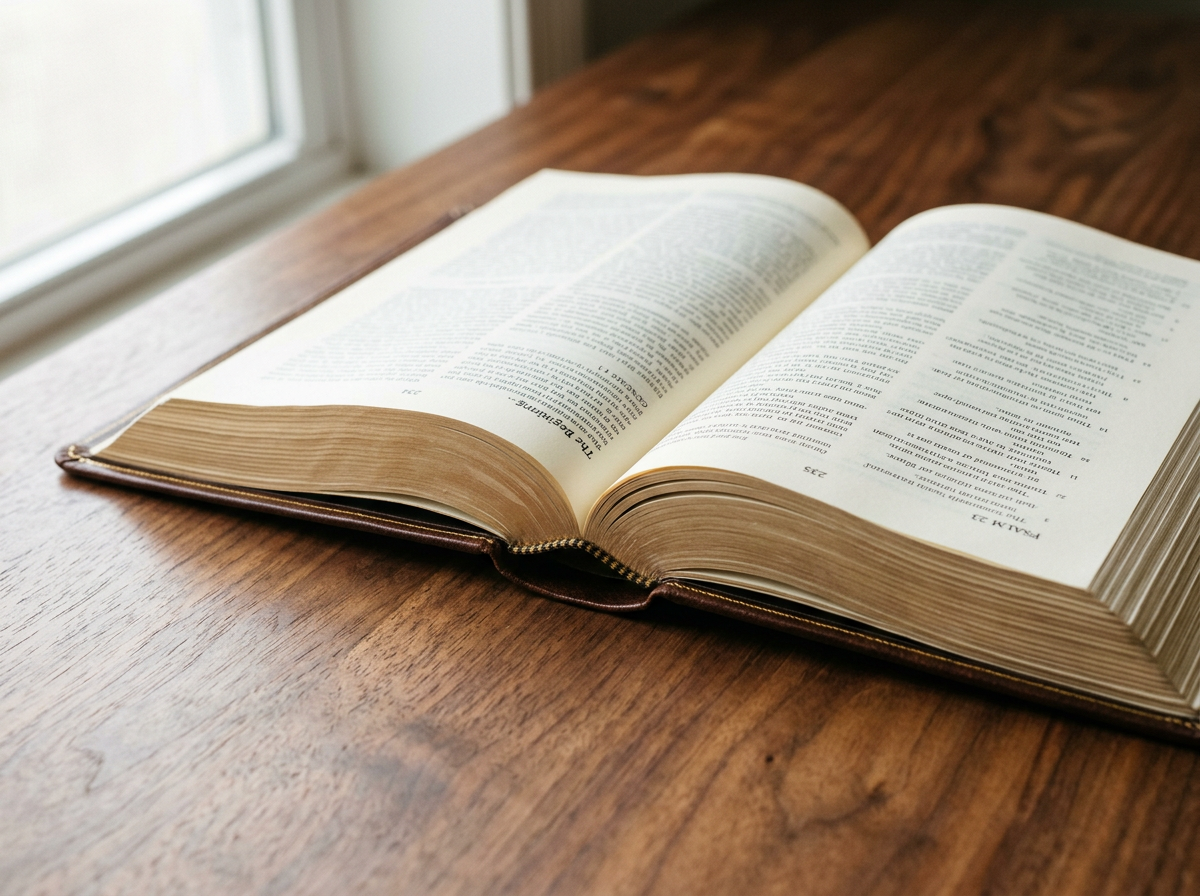
A leather Bible lying perfectly flat on a walnut desk in soft window light.
You don't need to be an expert to spot a well-made Bible. You don't need to know what Smyth sewing is, or what gsm Bible paper weighs, or where goatskin comes from. You just need to know what to look for — and most of it you can check in thirty seconds, in a bookshop, with no special equipment.
Here are five things. Run through them next time you're holding a Bible, and you'll be making a more informed judgement than ninety per cent of the people who buy one.
1. Does it open flat?
Hold the Bible open in one hand, somewhere near the middle. Does it lie flat in your palm, or does it fight you — the pages curling up, the text disappearing into the gutter where the binding swallows it? A well-bound Bible opens flat. A glued binding doesn't.
This isn't a small thing. A Bible is a book you'll hold in one hand, on a lap, on a lectern, in a hospital room. If you can't keep it open without pinning it down, you'll stop opening it.
2. Hold a page up to the light.
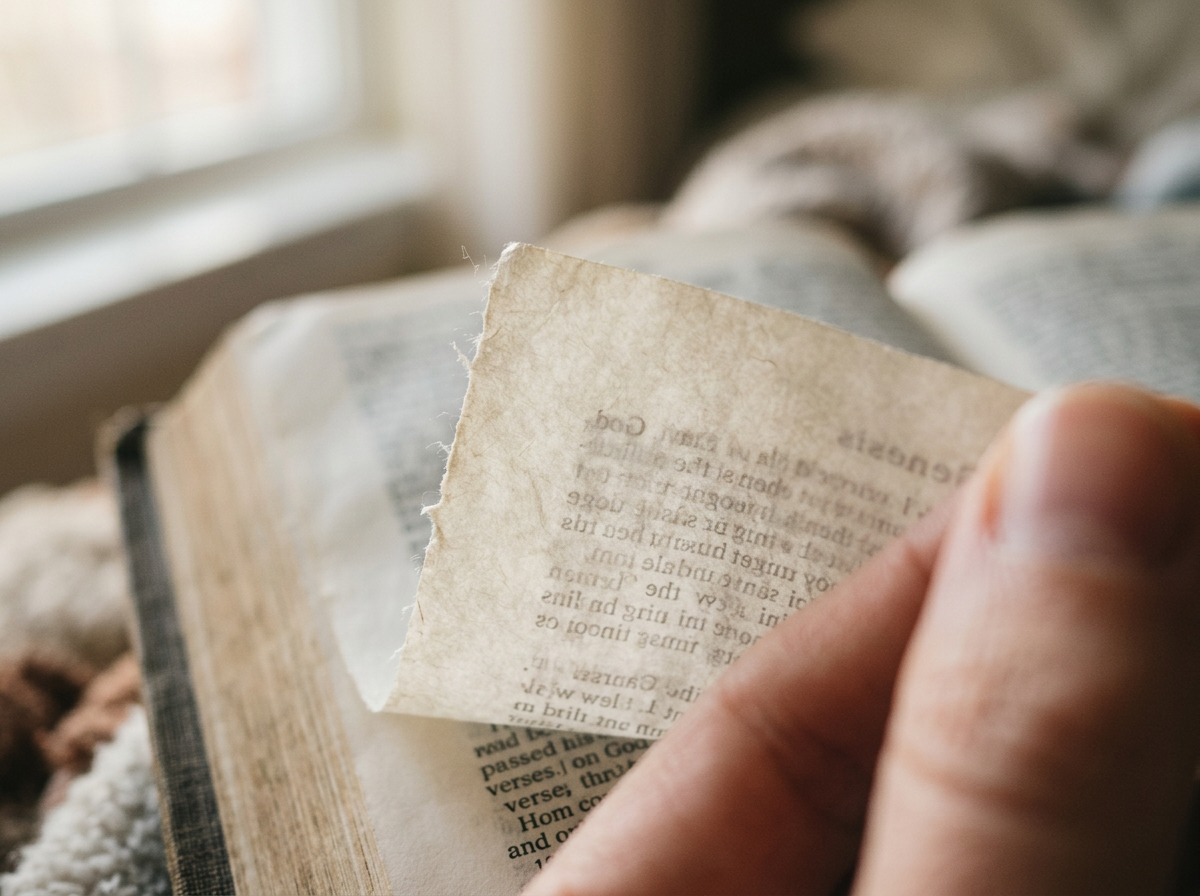
How much of the text from the other side bleeds through? A little is unavoidable — Bible paper is unbelievably thin, and that's part of what makes a Bible portable in the first place. But cheaper paper shows through so much that both sides become hard to read at once.
“Less show-through means better paper — and possibly line-on-line printing, where the text on each side is precisely aligned with the text on the reverse.”
3. Run your finger down the inner margin.
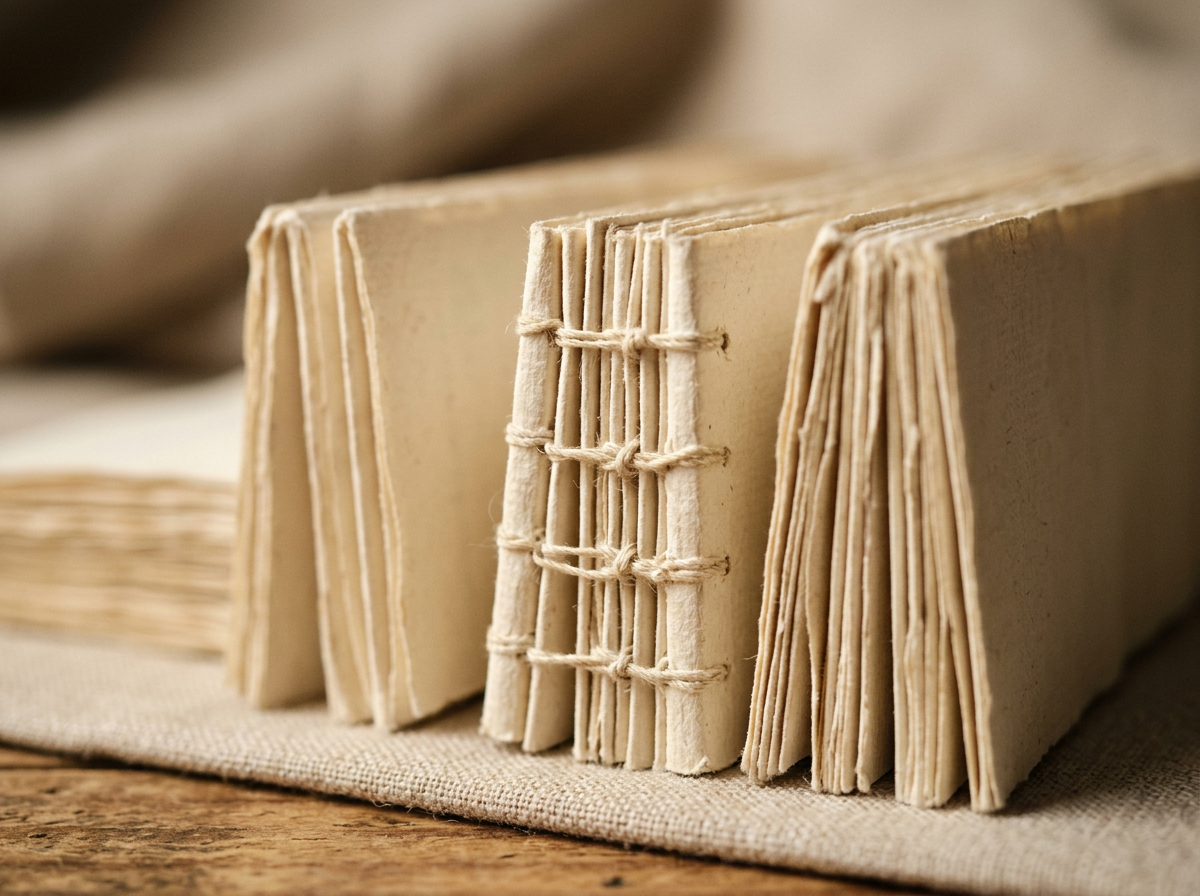
Smooth and crisp? Good. Crinkled, wavy, or rough? That's a sign the paper has been printed against the grain — a corner cut at the printing stage that ages badly and doesn't lie well on the page.
4. Look at the cover.
Is the leather flexible or stiff? Premium goatskin folds easily in your hand and falls open like a worn pair of jeans. Stiffer covers — bonded leather, imitation leather, or harder calfskin — tend to fight you.
Does the grain look natural, with subtle variation? Or is it a perfectly uniform stamped pattern? Real goatskin has the grain of an actual hide — sometimes with faint character marks. That's not a defect. That's the proof.
- ◆Look for a line of stitching around the perimeter of the cover — it adds beauty and structural strength.
- ◆Count the ribbon markers. One thin nylon ribbon is the bare minimum. Two or three thick satin ribbons signal a serious edition.
- ◆Check the head bands at the top and bottom of the spine — small fabric details whose colour is chosen on purpose.
5. Check the gilded edges.
Are they smooth and uniform, or patchy? On premium editions, fan the pages — you may see a flash of red, blue or burgundy beneath the gold. That's art gilt: an extra layer of dye applied under the foil that takes hours of additional finishing.
“A Bible is the most-used book most people will ever own. The binding is what determines whether it survives twenty years of daily use, or falls apart in two.”
And one more thing.
Open it. Read a paragraph. Does the typography invite you in, or push you away? Is the text legible at a comfortable distance? Are the columns generous, or cramped? You're going to be reading this book — possibly for years. The way it feels under your eyes matters as much as the way it feels in your hand.
Once you've checked these five things a few times, you'll start to do it automatically. And the next time someone hands you a Bible, you'll know — within a few seconds — whether it was made to last.
Every Bible we sell lists its paper weight, binding type and leather — so you can choose with the same care you've just been reading about.
See the collection