Sewn, not glued: the art of Bible binding
A glued spine cannot survive twenty years of daily use. Here's what does — and why.
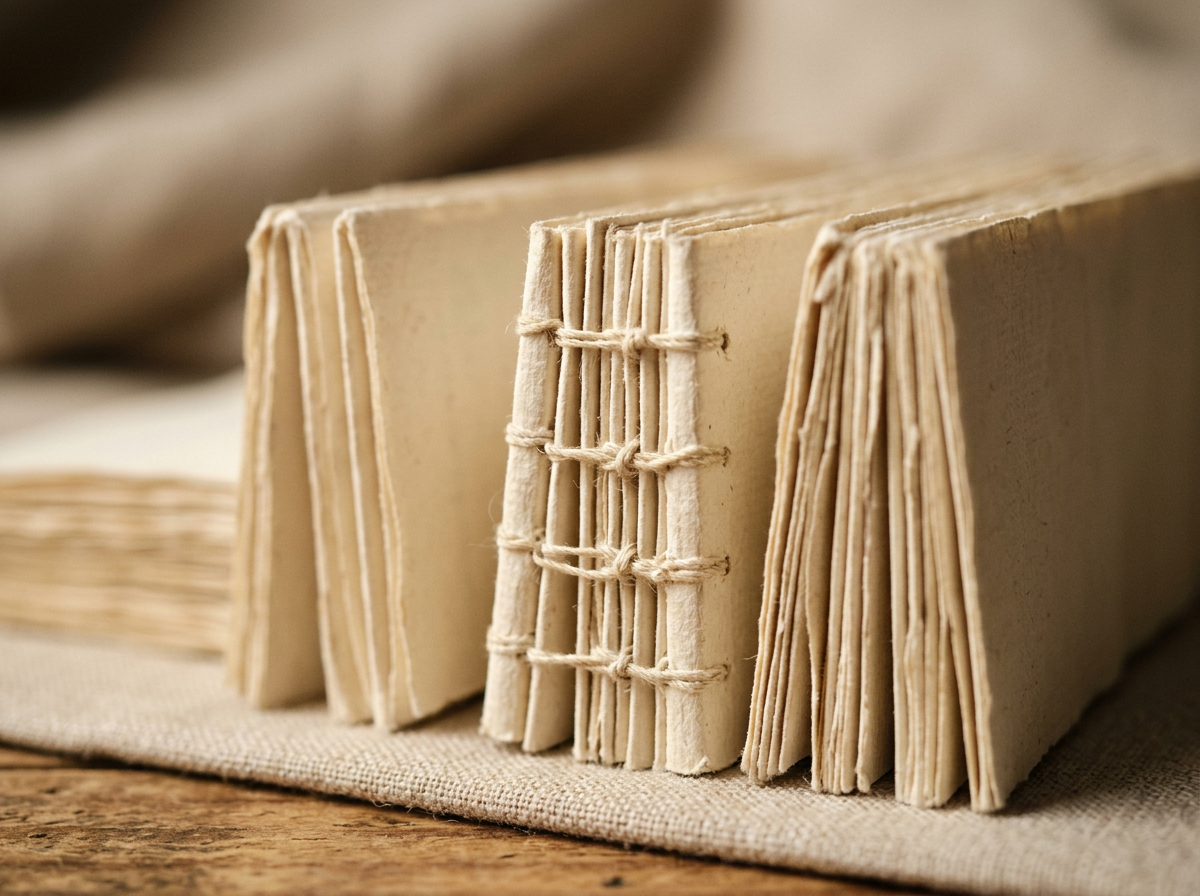
Macro of cream binders' thread stitched through Smyth-sewn signatures on a linen cloth.
Most modern books are perfect bound. The pages are cut flat at the spine, glued, and pressed into a cover. It's fast, cheap, and good enough for a thriller you'll read once on a beach.
A Bible is different. It's a book people return to daily, for decades. It's opened, held, carried, set on lecterns, balanced in one hand, marked with ribbons, scribbled in, slipped into bags. A glued spine cannot survive this. The glue cracks. The pages loosen. The spine breaks. The book dies.
“A Bible is the most-used book most people will ever own. The binding is what determines whether it lives twenty years or two.”
Smyth sewing: the gold standard.
The proper way to bind a Bible is called Smyth sewing, or section sewing. The pages are folded into nested groups called signatures — usually sixteen or thirty-two pages each. Each signature is stitched through the fold with binders' thread, and then the signatures are sewn to one another in turn.
The result is a book block that is simultaneously flexible and incredibly strong. Crucially, a Smyth-sewn Bible opens flat. The text doesn't disappear into the gutter, because the sewing allows the spine to flex naturally. You can lay it on a desk, take both hands off, and start reading.
Casing in: paste-off vs edge-lined.
After sewing, the book block is glued lightly along the spine — usually with a gauze fabric backing — to hold the signatures together. Then it's cased into its cover. Two methods dominate:
- ◆Paste-off — a semi-automated process where the cover is glued directly to the endpapers. This is how most mid-range Bibles are bound. Sturdy, but the stress of opening the book is taken by the text block itself.
- ◆Edge-lined — a specialist handcraft process where a piece of leather or liner is glued between the pages and the cover, taking the stress off the text block entirely. The cover and the pages move semi-independently. The book opens like a notebook. Cambridge and R. L. Allan use this method for their goatskin editions.
The hierarchy of leather.
If sewing is the bones of a Bible, leather is the skin. Not all leather is created equal, and the words on the box can hide a lot. Roughly from finest to most economical:
- ◆Goatskin (Morocco) — the finest. Natural grain, not stamped. Soft, supple, almost impossibly durable. Each cover is unique because the grain is the actual surface of the hide.
- ◆Calfskin — very soft and elegant, develops a beautiful patina with use.
- ◆Calf-split — the underside of split calfskin. Stiffer, with a stamped grain pattern. Still elegant.
- ◆French Morocco — taken from calfskin; an economical alternative.
- ◆Genuine leather — usually pigskin. Real leather, but stiffer and less refined.
- ◆Bonded leather — reconstituted leather scraps glued together. The cheapest leather option, and the least durable.
- ◆Imitation leather — synthetic. Modern versions can be surprisingly good.
The finishing details.
Beyond sewing and leather, a premium Bible is distinguished by a hundred small choices that most readers never consciously notice — but that they feel.
- ◆Yapp — the overhang of leather beyond the page edges, protecting them. A full yapp folds right over.
- ◆Hubs — the decorative raised ridges on the spine. Once functional, now expressive.
- ◆Perimeter stitching — a line of stitching around the cover edge, beautiful and structurally useful.
- ◆Overcasting — extra vertical stitching on the first and last signatures, reinforcing the binding at its weakest points.
- ◆Ribbon markers — premium Bibles get two or three thick satin ribbons; budget editions get one thin one, or none.
- ◆Head and tail bands — small woven fabric details at the top and bottom of the spine, in colours chosen to complement the leather.
“These details aren't decoration. They are the difference between a book that lasts a generation and one that doesn't.”
It's tempting to think of all this as ornament — the kind of thing only a collector would notice. But every detail above is functional. The thread keeps the pages in. The leather keeps the cover supple. The yapp protects the edges. The art gilt seals the paper. The ribbon helps you find your place. The head band reinforces the spine. Together they turn a stack of paper into something that can be opened every day for fifty years and still feel better at the end of it than the day it was bought.
That's what 'sewn, not glued' really means. It's not just a binding method. It's a philosophy about whether the book in your hand is built to be used, or built to be sold.
Every Bible we sell lists its paper weight, binding type and leather — so you can choose with the same care you've just been reading about.
See the collection